










GNSS Positioning Problems in Field Robotics: A Field Guide | Fixposition
Start with the symptom
These guides are written for engineers integrating positioning into outdoor robots. Each one starts from a fault as it actually appears in the field, explains the mechanism behind it, and lists what to check before concluding that the environment is at fault. Where a problem cannot be tuned away, we say so.
Losing accuracy
- Why does my robot lose RTK fix between buildings? — sky-view blockage, multipath and NLOS, and why no base station setting removes them.
- RTK drops to float under tree canopy — foliage attenuation, cycle slips, and why wet leaves are worse than dry.
- Multipath and NLOS in urban canyons — two different failures, and what each mitigation technique is really worth.
Wrong, but confident
- RTK says “fix” but the position is wrong — false fixes, datum mismatches and antenna height errors, diagnosed by the shape of the error.
- Position jumps after a GNSS outage — why the jump is your drift becoming visible, and what actually reduces it.
- Heading is wrong at low speed — course over ground is not heading, and the difference shows up at standstill.
Choosing an approach
- Localizing an outdoor robot when GNSS is blocked — six approaches compared, including the ones we do not sell.
- Does adding an IMU fix RTK dropouts? — how long dead reckoning really holds, and why vision changes the arithmetic.
- Choosing a positioning sensor for an outdoor AMR — the requirements that actually decide the choice, and the questions to ask a supplier.
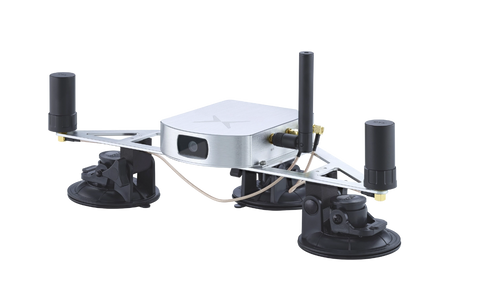
Precise global positioning everywhere. Fixposition's Vision-RTK 2 fuses vision, inertial and GNSS measurements to hold centimetre-level accuracy where RTK alone cannot. See the technology or talk to an application engineer.